Definition
frac·tal emer·gent com·plex·i·ty (noun)
The assertion that all elements in sufficiently complex biological systems will over time evolve to spontaneously exhibit one of a fixed set of fundamental collective behaviours.
Back to topRelated concepts that are different
Back to top
What is a system?
The term is little vague, like ‘freedom’, ‘concept’ or ‘election promises from a politician’. In our ever-changing world, the word 'system' gets thrown around a lot (particularly in the technology sector) but few of us probably stop to think carefully about what a system actually is, because hey, we all have lives and there's coffee to be consumed and new cat videos to laugh at.
If we ask our friend Wikipedia, it says:
A system is a group of interacting or interrelated elements that act according to a set of rules to form a unified whole
...which is only ever-so-slightly less vague than the word itself. But we can at least extract some useful concepts from this definition, namely, a system should:
- Have multiple elements
- The elements must interact with each other
- There must be a set of rules that define how some or all the elements behave
- Collectively, these elements (and their rules) must form a unified whole, which means they can't include other elements or rules as being 'part of' their system
Before we continue any farther, let's at least sanity check this definition against some accepted 'systems' to make sure we're on the right track:
| Has multiple elements? | Elements interact? | Set of rules defining behaviour? | Form a unified whole? | |
|---|---|---|---|---|
| Solar System | Yes. Planets, asteroids and sun(s) | Yes. Thanks to gravity. | Yes. Rules for gravity, solar radiation, etc. | Yes. |
| Health System | Yes. Hospitals, ambulances, health care workers, funding bodies, medical resarch institutions, etc. | Yes. | Yes. Policies, laws and local operating procedures define how all the elements should work. | Yes. |
| Respiratory System | Yes. Lungs, | |||
| Financial System | ||||
| Document Management System |
Ok, good - that definition seems to hold. Now that we are comfortable(ish) that we have a grasp of what a system is, let's make sure we understand the meaning of the individual words in fractal emergent complexity.
Back to topWhat are fractals?
In a word: fractals are awesome.
If you like math.
And recursion.
And ingesting psychedelic substances.
A fractal is any geometric shape that contains instances of itself within...itself. It's probably easier just to explain with a picture:
Here is a triangle-like fractal called the Sierpinski triangle - as you can see, no matter how how much you keep zooming in, no matter what 'level' you're at, you end up with a shape that is the same:
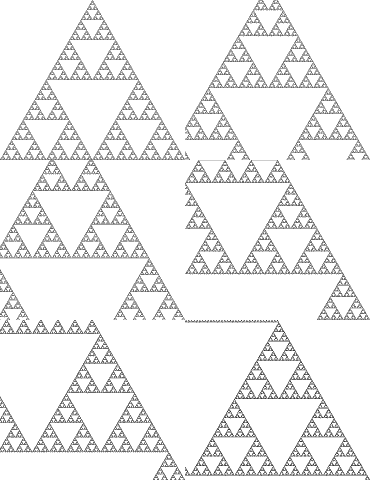
This geometric shape - and all fractals - effectively contain infinite copies of themselves, within themselves. These fractal shapes are defined mathematically, so one can keep 'zooming in' using an equation, rather than just zooming into a static picture that will eventually become blurry. You can try this for yourself online using the XaoS website.
So what do we mean if a shape is 'defined mathematically'? Well, it means that we can create the shape from nothing but a simple set of rules. So if we wanted to defined a square mathematically, we could do it like this:
- Draw a straight line of length L
- At the end of that line, turn left 90 degrees
- Repeat Steps 1 and 2 three more times
And the result:
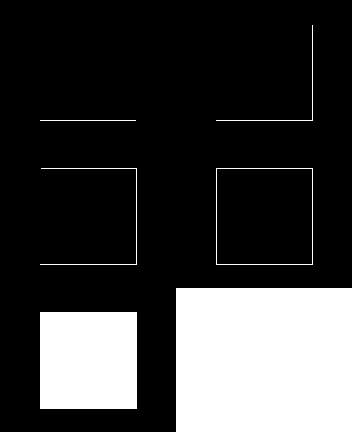
A square!
Notice that the actual length of the square is irrelevant to the final shape - we can replace 'L' in the above rules with any number and we'll still get a square. You can probably see how this can be applied to other simple geometric shapes like triangles or octagons.
Fractals are defined in a slightly more complex way. Rather than just defining simple "move and turn" steps, each step in the fractal takes into account some information about the previous steps, just as length or orientation. For example, a tree-like fractal can be defined by:
- Draw a straight line of length L
- At the end of this line, draw two more lines that are half the length of the previous line. The left line must be n degrees to the left and the right line must be n degrees to the right of the previous line.
- Repeat step 2 for each line drawn in the previous step.
This is how the shape looks after running the rules four times over:
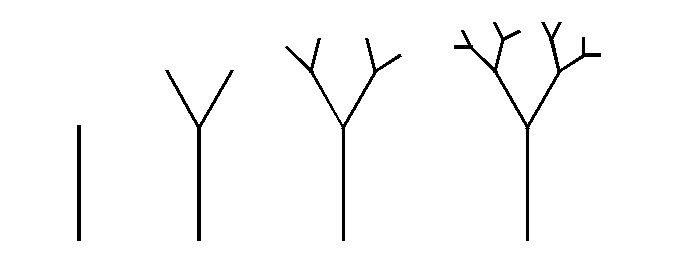
The Sierpinski triangle is just one example though; if you search for "Fractal examples" in Google Images you get a whole bunch of interesting fractals:

Interestingly, fractals do appear in nature as well. For example, in snow flakes, fern leaves and pine cones. Fractals also feature prominently recounting of psychedelic trips, with people ingesting substances such as LSD or DMT often visually hallucinating coloured, fractal-like shapes and patterns.
Anyway, for the purpose our definition, the main point to remember about fractals is that that they are the same at all "levels".
Back to top
What is emergence?
Right. Emergence.
If you thought fractals were a little abstract, buckle up, because emergence is even more abstract.
When humans work together collectively to achieve some complicated outcome, we tend create a hierarchical relationship of control, so that there's usually a single (or small group) of individuals who have a "big picture" view of things at the top, and they dictate how everyone beneath them should behave to achieve the overall objective. This generally makes things easier to successfully achieve the objective, as anyone who has ever had to design a website to appease a committee can attest, the idiom "too many cooks in the kitchen" is absolutely valid.
Militaries all over the world understand that humans being collectively involved in complex military operations can quickly fall apart without proper direction, and so they have their own name for this concept: C2 (because militaries loves acronyms...it's short for "Command and Control").
We see this "command and control" everywhere, not just with admirals directing fleets of warships, or generals directing platoons and infantries, but in all sorts of places:
- Governments direct state and national departments to behave in the national interest - the departments aren't expected to run by themselves and do whatever they want with taxpayer dollars
- Teachers direct the learning of the children in a classroom - the children aren't left in the room and told to figure it out themselves
- CEOs and executives direct the behaviour of their employees - the employees aren't told, "Do whatever you want and we'll see what happens"
- A construction manager directs the behaviour of construction workers to build a house - the workers aren't expected to figure out how to work together to build the house
Humans aren't the only creatures that coordinate complex behaviours in this way. Within the animal kingdom, we find ant colonies do the bidding of a queen, African elephants are led by the eldest female and killer whales have a similar social structure.
With all of these examples everywhere, you may be forgiven for thinking that the only way large groups of actors can collectively work together to achieve some intelligent objective is through this command and control structure.
But.
There are some cases where this isn't so - sometimes, we can observe some quite sophisticated behaviour spontaneously appearing from a collection of quite simple actors without having any kind of central 'controller' dictating the outcome. It just sort of...happens.
This phenomenon is called emergence.
Here are some examples of complex behaviours that are exhibited as a result of many 'dumb' agents following simple rules:
- Pacemaker cells in the heart all beat in synchrony, and yet there's no central 'conductor' cell that directs all the cells to beat in unison
- Starlings flock in complicated patterns, and yet there's no central leader directing the birds to move in a certain way
What is complexity?
Back to top